Online Gadamer Bibliography
Hermeneutical Movements now has an amazing online Gadamer Bibliography owing to the work of Carlo DaVia and David Vessey. You can access the Bibliography here: (http://hermeneuticalmovements.com/gadamer-translations/)

Hermeneutical Movements now has an amazing online Gadamer Bibliography owing to the work of Carlo DaVia and David Vessey. You can access the Bibliography here: (http://hermeneuticalmovements.com/gadamer-translations/)
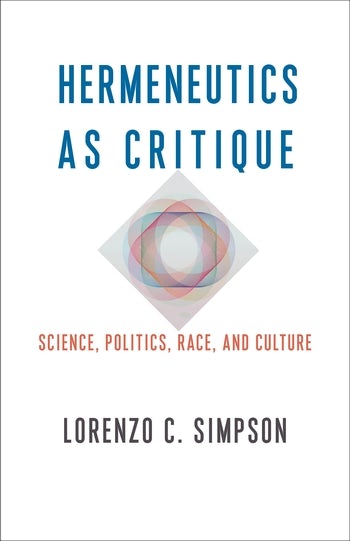
Dr. Lorenzo Simpson (Stony Brook University) has recently published a new book on hermeneutics that will, no doubt, be of interest to NASPH members and friends. The brief description below is taken from Columbia University Press. Congratulations, Lorenzo!
Brief Description
Hermeneutics has frequently been dismissed as useful only for literary and textual analysis. Some consider it to be Eurocentric or inherently relativistic and thus unsuited to social critique. Lorenzo C. Simpson offers a persuasive and powerful argument that hermeneutics is a valuable tool not only for critical theory but also for robustly addressing many of the urgent issues of today.
Simpson demonstrates that hermeneutics exhibits significant interpretive advantages compared to competing explanatory modalities. While it shares with pragmatism a suspicion of essentialism, an understanding that disagreements are situated, and an insistence on the dialogical nature of understanding, it nevertheless resolutely rejects the relativistic accounts of rationality that are often associated with pragmatism. In the tradition of Gadamer, Simpson firmly establishes hermeneutics as a resource for both philosophy and the social sciences. He shows its utility for unpacking intractable issues in the philosophy of science, multiculturalism, social epistemology, and racial and social justice in the global arena. Simpson addresses fraught questions such as why recent claims that “race” has a biological basis lack grounding, whether female genital excision can be critically addressed without invidious ethnocentrism, and how to lay the foundations for meaningful cross-cultural dialogue and reparative justice. This book reveals how hermeneutics can be a worthy partner with critical theory in achieving emancipatory aims.
Lorenzo C. Simpson is professor of philosophy at Stony Brook University. His books include Technology, Time, and the Conversations of Modernity (1995) and The Unfinished Project: Towards a Postmetaphysical Humanism (2001).
As David Vessey announced at the conference last week, we are starting an on-line Gadamer reading group this winter. The first meeting will be Sunday December 13th from 2:00-4:00 ET. We will be discussing “The Universality of the Hermeneutical Problem,” a lecture given in 1980 at The University of Pretoria and published in Lectures on Philosophical Hermeneutics, Universiteit van Pretoria, 1982. (Note that this is not the essay with the same title that is published in Philosophical Hermeneutics).
If you would like to participate, please contact David Vessey (davevessey@yahoo.com) for the Zoom link and a copy of the reading.
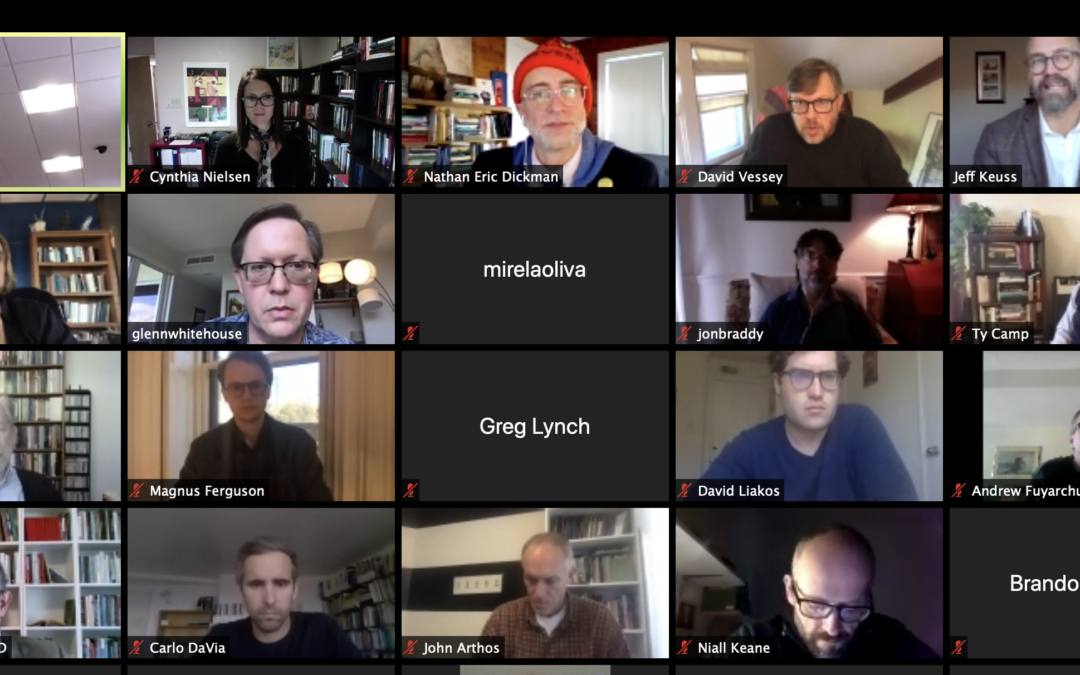
Many thanks to everyone who participated in our 15th annual NASPH conference (via Zoom). It was wonderful to see everyone and to discuss such rich and thought-provoking papers. We are especially thankful to Dr. Carolyn Culbertson for the work she did to live-stream our conference (masked and socially distanced) and for Florida Gulf Coast University for sponsoring the event.
As we announced earlier, this year’s NASPH annual conference will be held virtually on October 30 and 31. You can view the conference program here.
If you would like to attend, please send an email to nasphermeneutics@gmail.com. We will reply with a link to the Zoom session in which the conference will be hosted and the password that you will need to join. To help us avoid a last-minute backlog, we request that you send your email a week or so before the conference starts (but we will still accept requests received after that).
Below is the conference schedule. To help facilitate discussion we encourage participants to read the papers ahead of time. You can view the papers by clicking on the titles below.
Friday, 10/30, 2:00-5:25 EST
2:00-2:15: Welcoming Remarks/ About NASPH / Explanation of Program & Logistics
2:20-3:10: Presentation and Discussion: John Arthos, “Ich, das Wir, und das Wir, das Ich ist: Interrogating the I-lessness of Hermeneutic Understanding”
3:15-4:30: Keynote Presentation and Discussion: Lauren Barthold, “Enactivist Empathy and Dialogue“
4:35-5:25: Presentation and Discussion: Carlo DaVia, “Gadamer on Essences”
Saturday, 10/31, 10:00-3:30 EST
10:00-10:10: Welcome / Review of Program & Logistics
10:15-11:30: Keynote Presentation and Discussion: Theodore George, “Is Hermeneutics ‘Realistic’?: Two Responses and a Question”
11:30-12:15: Lunch break
12:20-2:10: Invited Panel Presentation and Discussion: “Ricoeur and the Just University,” Dan Boscaljon, Nathan Eric Dickman, Jeff Keuss, and Glenn Whitehouse
2:15-3:05: Presentation and Discussion: Magnus Ferguson, “Joycean Hermeneutics and the ‘Tyranny of Hidden Prejudices’”
3:10-3:30: Adjournment and Business Meeting
We are looking forward to ‘seeing’ you all and to an engaging dialogue.